
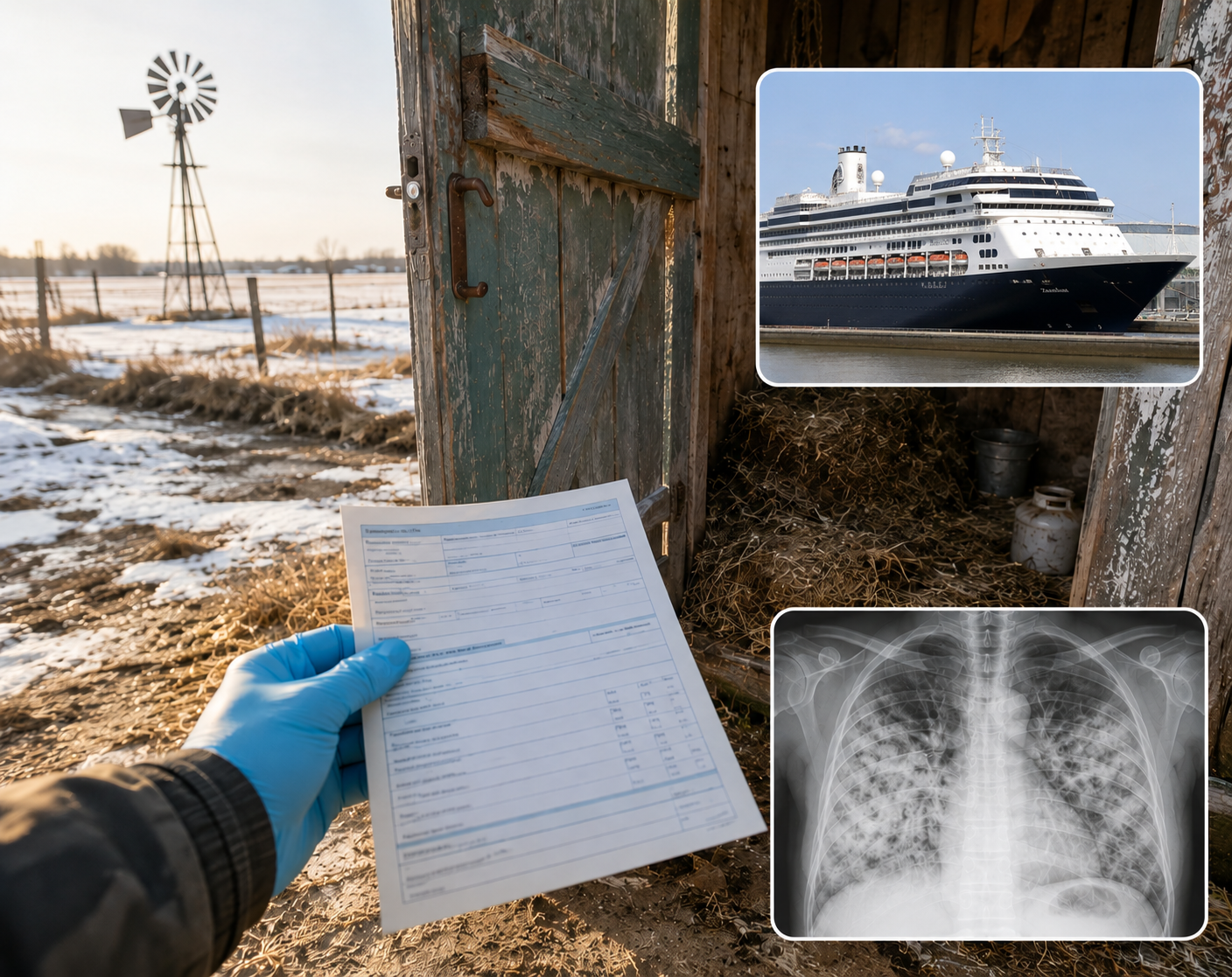
When a Dutch couple set off on a bird-watching excursion in Patagonia, they could not have anticipated that their holiday would spark an international outbreak — 9 confirmed cases aboard a cruise ship, 3 deaths, passengers quarantined across Europe, North America, and beyond. The pathogen at the center of it all: Andes virus, a South American hantavirus and the only strain known to spread from person to person.
In this episode of The Critical Care Commute, Peter Brindley and Leon Byker sat down with Professor Wendy Sligl — Critical Care and Infectious Disease Specialist — to unpack the virology, the clinical syndrome, and the ICU realities of hantavirus cardiopulmonary syndrome (HPS).
What Are Hantaviruses?
Hantaviruses are a family of zoonotic RNA viruses, carried by rodents and transmitted to humans primarily through inhalation of aerosolised rodent urine, faeces, and saliva. Two major clinical syndromes exist: Haemorrhagic Fever with Renal Syndrome (Old World — Europe and Asia) and Hantavirus Cardiopulmonary Syndrome (New World — the Americas). For North American intensivists, it is HPS that matters — specifically from Sin Nombre virus in the prairies and, increasingly relevant, Andes virus from South America.
The Cruise Ship Outbreak
The index case was a Dutch passenger who likely contracted Andes virus before boarding, during a bird-watching visit to a rodent-endemic site in Patagonia. The incubation period — typically 14 to 17 days, with a range of 4 to 42 days — means his symptoms appeared within days of sailing, confirming pre-embarkation exposure. His wife subsequently died three weeks later: person-to-person transmission, fitting perfectly with the incubation timeline.
Wendy is clear that this is not pandemic material. Andes virus person-to-person transmission requires prolonged close contact in a poorly ventilated space — an aircraft cabin or cruise ship cabin. No cases were documented from aircraft contacts seated more than two rows from an infected, symptomatic passenger.
Clinical Presentation: What to Expect
Prodromal phase (up to 5 days): fever, headache, myalgias, GI symptoms. During this phase, Andes virus patients are at peak infectivity.
Cardiopulmonary phase: non-cardiogenic pulmonary oedema, ARDS, and circulatory collapse driven by endothelial capillary leak. Mortality approximately 50%. The transition can be rapid and catastrophic.
Laboratory clues to consider: thrombocytopenia and hemoconcentration (rising haemoglobin from capillary leak) in the context of bilateral infiltrates and an appropriate exposure history. Testing: IgM serology acutely, PCR on whole blood, with genomic sequencing for strain identification.
ICU Management Principles
The pathophysiology drives the management: this is a capillary leak syndrome, not a volume-depletion state.
Fluid restriction is essential — target even to negative fluid balance. Vasopressors are preferable to volume boluses. Early referral to an ECMO-capable centre is not rescue therapy — it is the management plan. Both VV ECMO for refractory ARDS and VA ECMO for circulatory collapse have been used in HPS.
Regarding antivirals: favipiravir and similar agents may have a role during the prodromal viremic phase. By the time the patient is in the ICU, the disease is host-response-driven. Experimental immune modulators (icatibant, JAK inhibitors, IL-6 blockade) are under consideration with limited evidence.
Prevention and Exposure History
The single most important diagnostic act in suspected HPS is an exposure history — taken from the family when the patient cannot provide it. Western Canada (prairies) is the endemic zone for Sin Nombre; eastern Canada is not. Spring cleaning of sheds, garages, cabins, and trailers during deer mouse overwintering season is the classic exposure. Protective measures: wet-clean before sweeping, use bleach, wear gloves and a surgical mask, avoid aerosolising dried rodent material.
Further Reading
For those who want to go deeper: the New England Journal of Medicine has published key papers on the 2018 Argentinian Andes virus outbreak with person-to-person transmission, and a recent letter on the MV Hondius cruise ship cases. David Quammen’s Spillover remains the definitive lay text on zoonotic disease spillover events.
Listen to the full episode on The Critical Care Commute wherever you get your podcasts.
Leave a Reply